- Welcome to Hunan Shiney Steel Co., Ltd.


Here is a comprehensive side-by-side technical comparison to guide your material selection.
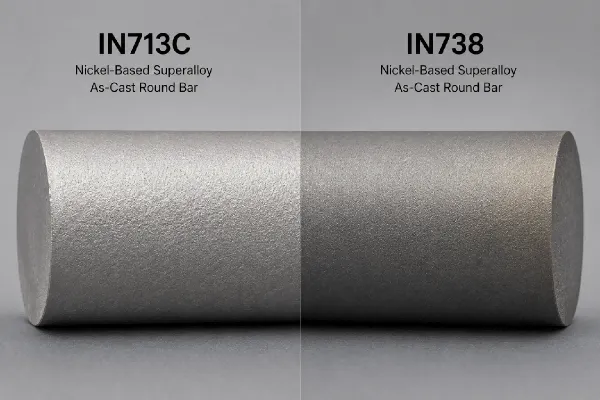
Both alloys are nickel-based and strengthened by precipitating γ′ phase (Ni₃(Al,Ti)). However, their alloying strategies are fundamentally different.
Inconel 713C was developed in the 1960s with a"pragmatic"philosophy. It contains 12.0–14.0% chromium and a high aluminum content of 5.5–6.5%, but only 0.5–1.0% titanium.Most notably, it contains virtually no cobalt– a significant cost-saving feature. The high Al content yields a γ′ volume fraction of approximately 20–25%. Niobium (1.8–2.5%) and molybdenum (3.8–5.0%) provide solid-solution and carbide strengthening.
Inconel 738 takes amore balanced and sophisticatedapproach. It contains 15.7–16.3% chromium and adds 8.0–9.0% cobalt, which enhances phase stability and high-temperature strength. Aluminum and titanium are carefully balanced at 3.2–3.7% each (total ≈ 6.8%). Additionally,738 incorporates multiple refractory elements– niobium, molybdenum, tungsten, and tantalum – for complex solid-solution strengthening. Its γ′ volume fraction reaches approximately 45%.
| Element (wt.%) | Inconel 713C | Inconel 738 | Role |
|---|---|---|---|
| Nickel (Ni) | Balance | Balance | Matrix |
| Chromium (Cr) | 12.0–14.0 | 15.7–16.3 | Oxidation/hot corrosion resistance |
| Cobalt (Co) | ≤1.0 | 8.0–9.0 | Phase stability, solid-solution strengthening |
| Aluminum (Al) | 5.5–6.5 | 3.2–3.7 | γ′ former |
| Titanium (Ti) | 0.5–1.0 | 3.2–3.7 | γ′ former |
| Molybdenum (Mo) | 3.8–5.0 | 1.5–2.0 | Solid-solution strengthening |
| Niobium (Nb) | 1.8–2.5 | 0.6–1.1 | Carbide/γ′ strengthening |
| Tungsten (W) | — | 2.4–2.8 | Solid-solution strengthening |
| Tantalum (Ta) | — | 1.5–2.0 |
High-temperature strength |
In terms ofstress-rupture strengthandcreep resistance, both alloys perform comparably within their respective temperature ranges. Inconel 713C delivers rupture life exceeding 100 hours at 870°C under 150 MPa stress. Inconel 738 exhibits similar rupture strength at equivalent temperatures.
However,tensile properties tell a different story. Original technical literature clearly indicates thatInconel 738 offers superior tensile performancecompared to 713C, attributed to its more complex multi-element solid-solution strengthening.
Regardingthermal fatigue resistance, available data shows Inconel 738 outperforms 713C at both 800°C and 900°C. At 900°C, for instance, 713C begins to crack after approximately 107 cycles, while 738 extends this to about 150 cycles.
This is the single most critical performance differentiator between the two alloys.
Extensive testing from original technical sources provides stark contrast:
Static Oxidation (1000 hours, still air):
| Temperature | Inconel 713C | Inconel 738 |
|---|---|---|
| 980°C | +0.6 mg/cm² (weight gain) | -16 mg/cm² (weight loss) |
| 1095°C | +29 mg/cm² | -102 mg/cm² |
(Negative values indicate spallation – the more negative the number, the poorer the scale adherence)
Hot Corrosion Test (930°C, 10% NaCl + 90% Na₂SO₄ molten salt crucible):
Inconel 713C:Completely destroyed within2–4 hours.
Inconel 738:Onlymild corrosionobserved after250–300 hours.
Gas Turbine Rig Corrosion Test (980°C, sulfur-bearing fuel + sea salt, 1000 hours):
Inconel 713C:Specimens completely consumed by corrosion.
Inconel 738:Only3.1 mgsurface loss, with a maximum penetration depth of0.38 mm.
The exceptional hot corrosion resistance of Inconel 738 stems from itshigher chromium content (16% vs. 13%)– chromium is essential for forming a protective Cr₂O₃ scale – combined with cobalt's stabilizing effect. This makes 738 remarkably resilient in sulfur-rich, salt-contaminated fuel environments where 713C fails catastrophically.
Inconel 713C is renowned for itsexcellent castability. With no cobalt and a simpler composition, it offers a wide casting window, high yield rates, and lower production costs. It is typically used in the as-cast condition without complex heat treatments.
Inconel 738 is more challenging to cast. Its high degree of alloying (especially cobalt, tungsten, and tantalum) creates a wider solidification range, increasing susceptibility to segregation and defects. To address this, INCO developedIN738LC (low-carbon, low-zirconium)version to improve castability in large-section components. 738 usually requires a full solution + aging heat treatment to achieve optimal mechanical properties.
Cost-wise, Inconel 713C is significantly more economical due to the absence of cobalt and tantalum. Inconel 738 pricing is more volatile, closely tied to global cobalt and tantalum market fluctuations.
Choose Inconel 713C when:
Service temperatures are below 900°C.
The operating environment is relatively clean (e.g., aviation kerosene).
Cost-effectiveness and high casting yield are priorities.
Components have complex geometries requiring excellent mold-filling capability.
Typical applications: aero-engine turbine blades, vanes, automotive turbocharger wheels.
Choose Inconel 738 when:
Service temperatures reach up to 980°C with long-term strength retention.
Severe hot corrosion is a major concern– e.g., industrial gas turbines using low-grade/sulfur-bearing fuels, or marine gas turbines exposed to salt spray.
Superior oxidation resistance and long-term microstructural stability are required.
Typical applications: industrial gas turbine hot-section components, marine/offshore turbine blades.
| Dimension | Inconel 713C | Inconel 738 |
|---|---|---|
| Core Strength | Cost-effective, excellent castability | Superior hot corrosion & oxidation resistance |
| High-Temperature Strength | Excellent (≤900°C) | Excellent (≤980°C) |
| Tensile Performance | Good | Significantly superior to 713C |
| Hot Corrosion Resistance | Poor (fails rapidly in sulfur-bearing environments) | Exceptional (10× to 100× better than 713C) |
| Cobalt Content | None | ~8.5% |
| Casting Difficulty | Low | Moderate to high (LC version available) |
| Relative Cost | Lower | Higher |
| Ideal Service Environment | Clean fuels (aviation kerosene) |
Low-grade / high-sulfur fuels, marine environments |
Choose 713C if you prioritize cost efficiency, casting simplicity, and operate in relatively clean environments.
Choose 738 if you face aggressive hot corrosion threats, demand longer service intervals, and require robust performance under harsh fuel or salt-laden conditions.
The choice ultimately boils down to atrade-off between economics and environmental tolerance.
At Shiney Steel, we have extensive experience casting both Inconel 713C and Inconel 738, including IN738LC, to meet the most demanding specifications. Whether your priority is cost optimization or corrosion resistance, we are your partner in precision alloy solutions.


 86-18666626534
 8618666626534
 sales@shineycast.com
 English
 Русский язык