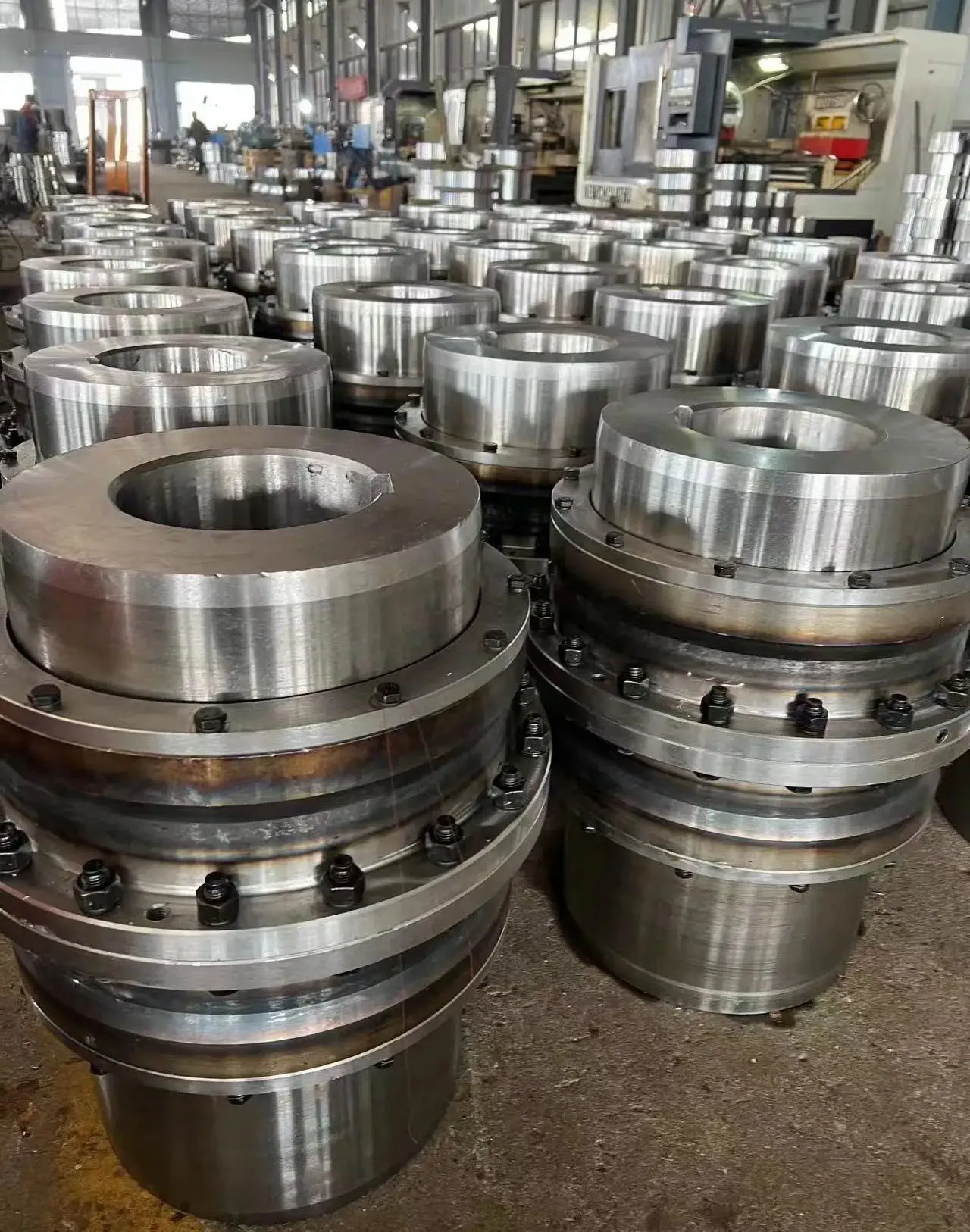
We recently received an order for a custom gear coupling – a critical power transmission component for heavy industrial machinery. And we're handling every step in-house: from forging the raw blanks to final assembly and testing.
Why gear couplings matter
Gear couplings are used to connect driving and driven shafts in mechanical power transmission assemblies. They consist of two hubs with external gear teeth and a connecting sleeve with matching internal gear teeth. Gear couplings are widely used in industries where high torque and low backlash are essential – mixers, rolling mills, conveyors, crushers, pumps, blowers, cranes, and other heavy-duty power transmission systems.
They need to be built tough – because when a gear coupling fails, production stops.
The forging advantage
For critical applications like gear couplings, forging is non-negotiable. Here's why:
🔹 Superior grain structure – Forging aligns the steel's grain structure, creating a component that is significantly stronger, tougher, and more resistant to fatigue and shock loads than an equivalent cast part.
🔹 Elimination of internal defects – Free forging eliminates defects such as shrinkage cavities, shrinkage porosity, and pores that are common in cast blanks. Forging materials have the advantage of increased material density and no casting defects.
🔹 Superior mechanical properties – Forged steel offers tensile strength 75% higher than cast alternatives (700-900 MPa vs. 400-500 MPa) and can endure over 10 million cycles of stress variation, compared to casting which often fails after just 100,000 to 1 million cycles.
🔹 Longer service life – Forging provides a refined grain structure that is far superior to casting in terms of strength, toughness, and fatigue resistance. The continuous grain flow established in forging virtually eliminates residual stresses, resulting in substantially higher component life.
Our process – end to end
For this gear coupling order, our production chain covers every step:
Material selection – High-quality alloy steel billet, selected for the specific torque and service requirements
Open-die forging – Multi-stage forging process with precise temperature control to achieve the required blank geometry and grain structure. The forging process typically involves heating the steel ingot, upsetting, drawing out, and cogging down.
Heat treatment – Quenching and tempering to achieve the optimal balance of hardness and toughness. Rough machining is often carried out before heat treatment.
CNC machining – Precision turning, gear hobbing, and tooth profiling to meet exact dimensional specifications. CNC lathes, milling machines, and machining centers achieve tolerances up to ±0.01mm.
Quality inspection – 100% dimensional verification and NDT
Assembly & testing – Final fit-up and performance validation before shipment
Quality you can rely on
Every gear coupling we produce undergoes rigorous quality control:
✅ Dimensional verification – CMM inspection of bore, keyway, and tooth geometry
✅ Material traceability – Complete documentation from melt to finished component
✅ Non-destructive testing – UT and MT inspection as required
✅ Performance validation – Fit-up and run-out checks before shipping
Why choose Shiney Steel for gear couplings?
🏆 One-stop capability – Forging, heat treatment, machining, and assembly – all under one roof
🏆 Deep material expertise – We understand how alloy selection and processing affect final performance
🏆 Proven quality – Every component is inspected and documented
🏆 Global shipping – Reliable delivery to customers worldwide



 86-18666626534
 8618666626534
 sales@shineycast.com
 English
 Русский язык